Cancer In Motion

This manuscript offers a disciplined, systems-level reframing of cancer, intended to recalibrate how the disease is understood at a conceptual level—by clinicians, scientists, and thoughtful readers seeking a clearer way to make sense of a complex disease. It does not propose a therapeutic program, clinical recommendation, or policy position. Rather, it develops a coherent intellectual framework that aligns contemporary biology with the observed realities of cancer behavior, intervention, and persistence.
Across eight chapters, the book traces a continuous arc. It begins by situating cancer as a living biological system rather than a static pathology—one whose behavior emerges from interaction, constraint, and time, rather than from isolated defects alone. It then examines the internal biological programs that generate heterogeneity, resilience, and adaptability, showing why persistence is not anomalous but structurally embedded.
Subsequent chapters consider intervention as pressure rather than verdict. Treatment, immune constraint, and environmental forces are framed as conditions absorbed by the system, reshaping trajectories without guaranteeing resolution. Over longer horizons, persistence, drift, and memory are revealed as systemic properties rather than episodic failures. Cancer unfolds along trajectories, not toward definitive endpoints.
Midway, the manuscript shifts from biological description to interpretation. It explores how understanding itself takes shape in the presence of complexity—why explanation alone cannot settle meaning in adaptive systems, and how integration across scales can yield coherence without closure. The later chapters address implication: how a systems-based perspective reshapes expectations about control, progress, success, and failure, without translating insight into instruction.
The final chapter closes quietly, without optimism or prescription. It offers an orientation rather than a conclusion: a way of holding knowledge, uncertainty, and lived experience together over time. The manuscript’s value lies not in answers delivered, but in alignment achieved—between biological reality and how cancer is framed, discussed, and understood.
In this sense, the book is intended as a conceptual anchor. It offers a shared way of thinking about why cancer rarely follows straight lines, why progress can appear uneven, and why apparent setbacks do not always signal failure. By grounding interpretation in how living systems behave over time, it helps readers—patients, clinicians, and decision-makers alike—make sense of uncertainty, mixed signals, and long horizons with greater clarity and honesty.
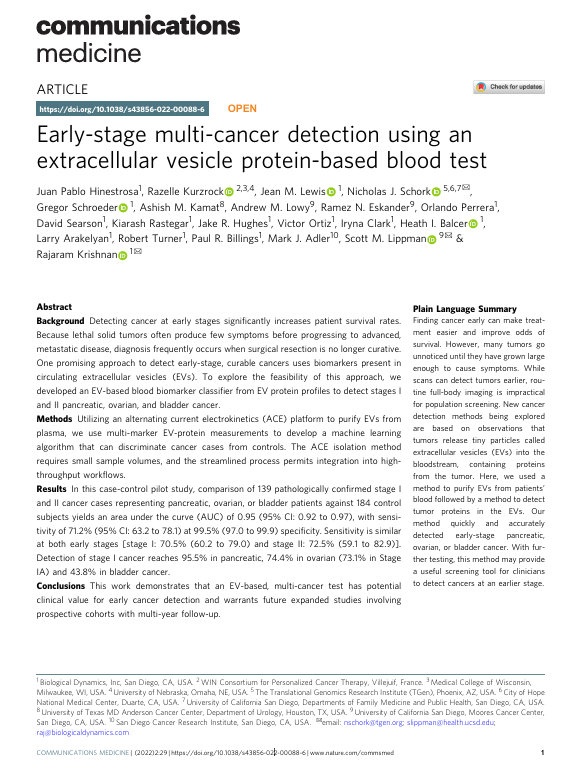
Early-stage multi-cancer detection using an extracellular vesicle protein-based blood test
Plain Language Summary
Finding cancer early can make treatment easier and improve odds of survival. However, many tumors go unnoticed until they have grown large enough to cause symptoms. While scans can detect tumors earlier, routine full-body imaging is impractical for population screening. New cancer detection methods being explored are based on observations that tumors release tiny particles called extracellular vesicles (EVs) into the bloodstream, containing proteins from the tumor. Here, we used a method to purify EVs from patients’ blood followed by a method to detect tumor proteins in the EVs. Our method quickly and accurately detected early-stage pancreatic, ovarian, or bladder cancer. With further testing, this method may provide a useful screening tool for clinicians to detect cancers at an earlier stage.
Understanding Cancer as a Process
This guide addresses what cancer is—not as a diagnosis or a prognosis, but as a biological process. Whether the reader is a student, clinician-in-training, scientist from another discipline, or anyone seeking foundational clarity, the three chapters that follow provide the conceptual framework upon which everything else in this book rests.
Cancer is often described as "cells growing out of control," and while that description is accurate, it is incomplete. Cancer is better understood as a progressive breakdown of the systems that normally regulate cell behavior—a gradual erosion of checks, balances, and fail safes that ordinarily prevent any single cell from acting independently of the needs of the whole organism.
Understanding cancer this way—as a process rather than an event—clarifies much that might otherwise seem puzzling. It explains why cancer typically develops over years or decades rather than appearing suddenly. It explains why early detection matters: not simply because smaller tumors are easier to treat, but because early cancers have lost fewer control systems and remain more responsive to intervention. It explains why treatment often requires multiple approaches, and why recurrence does not necessarily represent treatment failure but rather the persistence of cells that had already acquired significant independence.
The chapters move from the general to the specific. Chapter 1 introduces the central concept of cancer as lost balance—the idea that malignancy emerges when multiple regulatory systems fail simultaneously. Chapter 2 examines how cancer cells grow, exploiting normal biological machinery in abnormal ways. Chapter 3 addresses how cancers spread—the process of metastasis that accounts for most cancer deaths.
This forms the essential conceptual foundation for cancer. The concepts introduced here—clonal evolution, the stepwise accumulation of abnormalities, the difference between growth and spread form the foundation for understanding why cancers behave as they do, why different cancers require different treatments, and why the same cancer can behave so differently in different patients
COMBINTORIAL PARADIGM OF ONCOLOGY
SUMMARY
ANTIBODY THERAPY FOR CANCER
SUMMARY
CAR-T CELL REVIEW
SUMMARY
TITLE
SUMMARY